
From Patent to Product: The Missing Legal Infrastructure
Ravi Bhardwaj · 27.11.2026 · For Private Universities, Deemed Universities
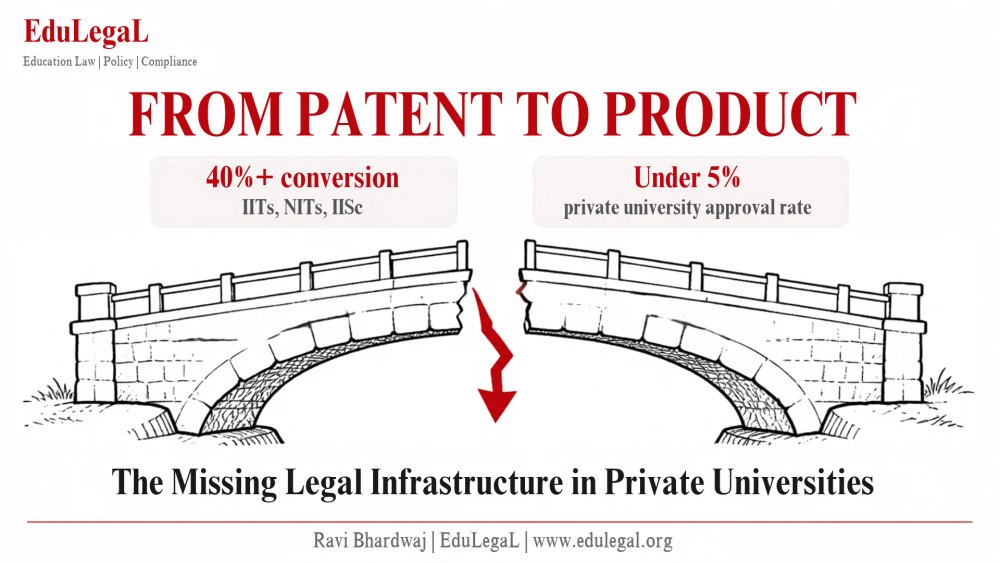
Indian universities were granted roughly 9,800 to 10,600 patents between 2020 and 2025. Nearly 40 percent came from just 55 public institutions (the IITs, NITs and IISc Bengaluru), which convert over 40 percent of what they file into granted patents. Private universities file in far greater volume but convert under 5 percent, which points to a missing screening step at the filing stage. Even where a private university does get a patent granted, it typically has no IPR Policy, Technology Transfer function, Assignment Agreements, Licensing framework or Incubation Policy to carry the invention to market. The article sets out the eight pieces of legal infrastructure, from pre filing screening through to commercialisation, that institutions need to build.
Indian universities were granted roughly 9,800 to 10,600 patents between 2020 and 2025. Nearly 40 percent of those came from just 55 public institutions, namely the 23 IITs, 31 NITs and IISc Bengaluru, which converted over 40 percent of their patent applications into granted patents. Major private universities, by contrast, filed tens of thousands of applications in the same period, but their approval rates often languished below 5 percent.
The usual conversation around such data is about research culture, faculty incentives and funding. That conversation misses something sharper. The gap is not primarily about private universities failing to attempt research, since the filing numbers show the opposite. Most of what gets filed simply does not survive examination, and that points to the screening and drafting stage, well before a patent is ever granted, not only to what happens after. Even where an invention does clear examination and the patent is granted, the institution typically has no legal infrastructure in place to carry the same from grant to product. The patent gets filed, sometimes gets granted, and then sits on a certificate in a file.
EduLegaL discusses the missing infrastructure actually from the filing stage through to commercialisation:
1. A Patentability Screening Process Before Filing: Filing in volume without an internal screening step is what produces a large filing count and a low grant rate. The IITs and NITs run a considered internal filter before an application goes out, testing novelty, inventive step and drafting quality. A private university does not need a patent cell the size of an IIT's, but it does need a committee, or even a single designated patent lawyer, with the authority to tell a faculty member that an invention is not ready to file yet. In the event that this step is skipped, the institution spends on filing fees and attorney time for applications that were never going to clear examination.
2. A Strong University IPR Policy: Most private universities either have no IPR Policy or have adopted a template document that nobody follows. A workable policy must state, in plain terms, who owns an invention made using institutional resources, how a faculty member or student is compensated when the same is commercialised, and what happens when external funding or a sponsored research agreement is involved. In the event that the policy is silent on ownership, every later step, licensing included, becomes legally uncertain.
3. A Properly Constituted Technology Transfer Office: An IIT's Technology Transfer structure is not an administrative convenience. It is a dedicated legal and commercial function that negotiates licences, drafts assignment deeds and manages the institution's patent portfolio as an asset. A private university does not need a replica of this scale, but the said function, even as a two person cell reporting to the Registrar, needs a defined mandate, a budget and legal backing. Without the same, no one in the institution is actually responsible for taking a patent anywhere.
4. Invention Disclosure and Assignment Agreements: Before a patent application is even filed, a faculty member or research scholar should execute an Invention Disclosure Form and an Assignment Agreement vesting rights in the institution, subject to the agreed revenue share. Institutions that skip this step frequently discover, at the point of commercialisation, that the inventor never actually assigned rights to the university, which leaves the institution without clear title to license or sell the same.
5. Licensing and Revenue Sharing Agreements: A granted patent has commercial value only where it can be licensed to an industry partner or spun out into a company. This requires a template Licensing Agreement covering exclusivity, royalty structure, minimum commercialisation obligations and termination rights, and a parallel Revenue Sharing Policy that tells the inventor what they stand to receive. Industry partners are reluctant to negotiate licences with an institution that has no standard agreement to offer, since every negotiation then starts from a blank page.
6. An Incubation and Startup Legal Framework: In the event that a patent is better suited to a university linked startup than to an external licence, the institution needs an Incubation Policy that addresses equity stake, use of institutional facilities and brand, conflict of interest for the faculty founder, and exit. AICTE and UGC have both pushed institutions toward Innovation Councils and incubation cells, but a council without a legal framework behind it is a committee, not infrastructure.
7. A Conflict of Interest and Faculty Engagement Policy: A faculty member who commercialises their own invention through an external company they control sits in an obvious conflict position. This is manageable, and in fact common even at the IITs, but only where the institution has a written Conflict of Interest Policy requiring disclosure, Board or Committee approval, and a clear separation between the faculty member's institutional duties and their commercial interest in the venture.
8. Alignment With the Regulatory Mandate: The National Education Policy 2020 and the UGC's push toward research intensive universities both assume that institutions will build this infrastructure on their own initiative. NAAC and NIRF now also reward patent filings and commercialisation outcomes in their assessment framework. An institution that chases the filing count alone, without the screening, drafting and commercialisation infrastructure behind the same, will keep filing applications that do not clear examination, and will keep sitting on the few that do, which defeats the very purpose the regulatory push is designed to serve.
The Way Forward
None of the eight steps above requires IIT scale resources. What they require is a decision at the Governing Body level to treat intellectual property as an institutional asset class, screened and drafted with the same rigour at the filing stage as it is managed at the commercialisation stage, rather than as a by product of faculty research that the institution notices only when a certificate, or a rejection, arrives. A private university that builds even a modest version of this infrastructure will see a higher proportion of its filings converted into grants, and a higher proportion of those grants converted into products, long before it ever catches up with the IITs on volume.
Institutions that would like to put this infrastructure in place, whether by way of a patentability screening process, a fresh IPR Policy, Assignment Agreements, Licensing Agreements or an Incubation Policy, are welcome to write in.
Ravi Bhardwaj | Founder | EduLegaL | www.edulegal.org | mail@edulegal.in
Need advice on this?
EduLegaL, A Division of RSB LegaL. Write to us at mail@edulegal.in or use the contact page.
This page gives general information only and is not legal advice. Please read the original text before acting.