
Supreme Court backs IISc in discharging a probationer professor, draws the line between unsuitability and punishment
18.11.2026 · Supreme Court of India · Dr. G. Srinivasan v. Union of India and Others
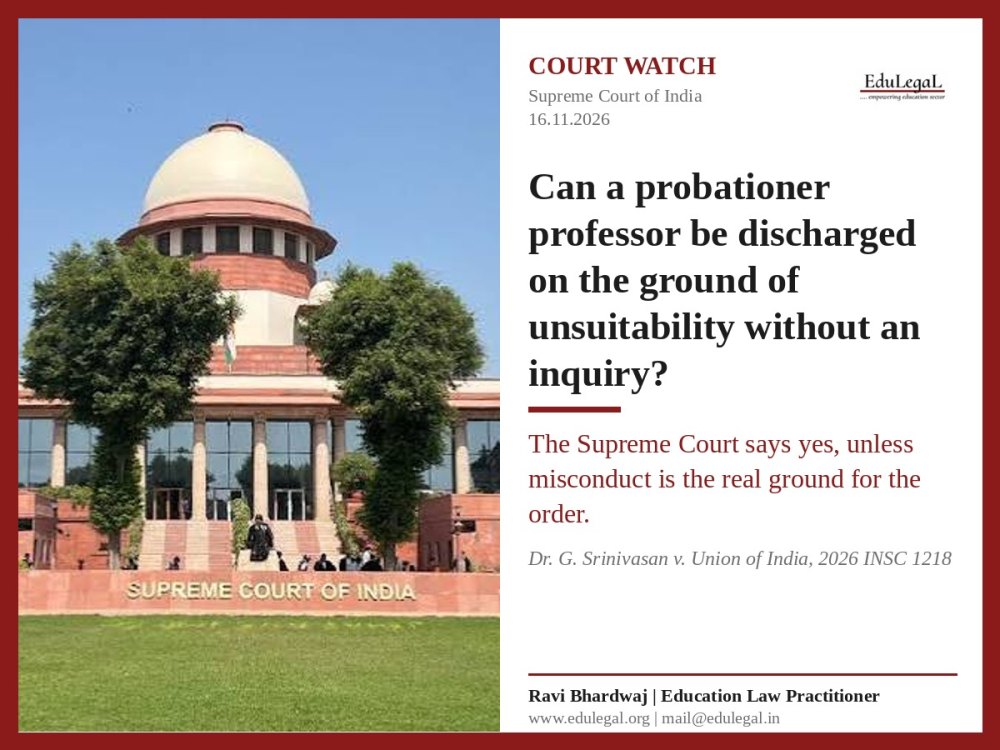
The Supreme Court has upheld the discharge of an Associate Professor on probation at the Indian Institute of Science, Bengaluru, holding that the order was a bona fide assessment of suitability under the Institute’s Regulations and not a punishment for misconduct. The Court has laid down a structured framework for deciding when the discharge of a probationer is termination simpliciter and when the same becomes punitive and stigmatic, requiring an inquiry.
Every university, college and research institute faces this question at the end of a probation period: can a probationer be let go for unsuitability without an inquiry, or does the complaint that triggered the review turn the discharge into a punishment? The Supreme Court has now answered the same with a clear framework.
Standing law
A probationer has no right to the post until confirmed. Probation is a period of trial, and the employer may discharge a probationer found unsuitable, during or at the end of the period, without holding an inquiry. The exception is where the discharge is in truth a punishment for misconduct. The courts ask what really drove the order. If a complaint only prompted the employer to look at the probationer’s suitability, and the decision was then taken on overall suitability, the complaint is merely the motive and the discharge is not punishment. If, instead, the employer went into the complaint, concluded that the misconduct was proved, and discharged the probationer because of that conclusion, the misconduct is the foundation of the order, and the order is a punishment that cannot be passed without an inquiry and a hearing.
Facts
The appellant was appointed in 2011 as an Associate Professor at the Centre for Earth Sciences at IISc on a five year contract, with the first year on probation, governed by the Institute’s Scheme, Regulations and Bye Laws. A Committee of Professors reviewed his performance in 2012 and recommended extension of probation by a year, which the Institute accepted. A newly constituted Committee reviewed him again in March 2013 and recommended that his services be discontinued. By office memorandum dated 10.04.2013, issued under Regulation 13.5, which permits termination on one month’s notice without assigning reasons, the Institute terminated his services. As the Court records in paragraph 10 of the judgment, what weighed against him was his unsuitability for the Institute owing to his inability to get along with co-workers, and the absence of any change in his behaviour after the extension of probation.
The Karnataka High Court dismissed his writ petition and the writ appeal in 2013. He approached the Supreme Court only in 2016, when his five year contract had almost run out. Before the Supreme Court he argued that the order was punitive in substance, that the Committee had recorded findings against him without notice or hearing, that the Chairman of the Centre was biased against him and had influenced the Committee, and that Regulation 13.5 was arbitrary.
What the Court held
The Court set out parameters for examining the discharge of a probationer:
- Probation exists to let the employer assess suitability and discharge an unsuitable employee without a formal inquiry.
- A court may lift the veil only to see whether unsuitability is the real ground or a cloak for punishing a specific misconduct. The court cannot re-appreciate suitability.
- The motive and foundation test is a substantive inquiry on the whole record, not a mechanical reading of the words of the order.
- Words like “unsatisfactory” or “unsuitable” are not stigma. Stigma is tested by three questions in sequence: does the order on its face impute anything against the probationer; if not, does the record show that the foundation is a finding of misconduct rather than an assessment of suitability; and does that foundation visit the probationer with civil consequences affecting future employment. Stigma arises only if the second and third answers are both yes. A grievance, a complaint or an adverse perception, without more, is not enough..
- The final question is whether the termination was a bona fide assessment of suitability or a punishment for a specific act without the protection of an inquiry. The first stands as termination simpliciter; the second cannot survive without due process.
Applying these, the Court found no material showing that any specific allegation of misconduct had been investigated and found proved against the appellant, or that such a finding was the foundation of the order. The Institute had two courses open to it when material about his conduct came up: hold an inquiry, or simply discharge him without civil consequences. The Institute chose the second, which was within its power. The challenge to Regulation 13.5 was rejected as misconceived, since a probationer cannot insist on reasons in every case of discharge. The appeal was dismissed with no order as to costs.
EduLegaL View
The judgment is reassuring for institutions, but the protection rests on three things. The service rules or appointment letter must provide for discharge of a probationer during or at the end of probation. The suitability assessment must exist on the file before the order, made by a committee or competent authority in the ordinary course, not assembled after a challenge. And the order itself must stay plain; it should not narrate complaints, findings or conclusions. In the event that an institution really wants to act on a specific act of misconduct, the only safe route is a charge sheet and an inquiry.
Ravi Bhardwaj, Education Law Practitioner
www.edulegal.org | mail@edulegal.in
Read the Judgment
Source: Supreme Court of India
Related: Universities, Private Universities, Deemed Universities
Need advice on this?
EduLegaL, A Division of RSB LegaL. Write to us at mail@edulegal.in or use the contact page.
This page gives general information only and is not legal advice. Please read the original text before acting.