
Student exchange abroad is celebrated. Student exchange within India barely exists. Why?
Ravi Bhardwaj · 15.11.2026 · For Universities
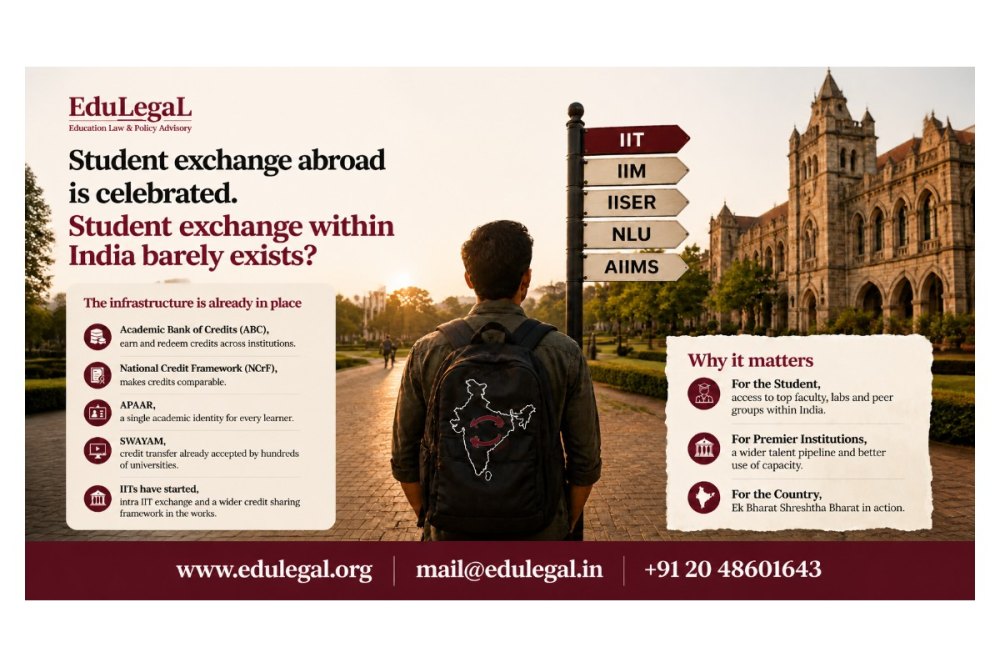
Every university brochure lists its foreign partner universities. Very few list an Indian one. The infrastructure exists. The regulations exist. The IITs have started. What is missing is a scheme that makes domestic exchange an enabling and encouraging experience for students and institutions.
Every university brochure lists its foreign partner universities. Very few list an Indian one. Why ?
Yet the platform domestic mobility is already built. The Academic Bank of Credits lets a student earn credits at one Indian institution and redeem the same at another. The National Credit Framework makes those credits comparable. APAAR gives every learner a single academic identity. Several hundred universities already accept a substantial share of a semester’s credits from SWAYAM, which is credit transfer from an institution the student never physically attended.
And the IITs have just proved the model. Earlier this year, the IIT Council’s minutes recorded a target for undergraduate student exchange across the IITs, with credit transfer for courses taken at another IIT. In February, IIT Madras announced the first official intra IIT academic mobility from the coming academic session. IIT Madras has also been tasked with designing a credit sharing framework that extends to NITs, IIITs, IISERs and NLUs. The IISERs are preparing a one semester exchange among themselves.
So the question is no longer whether domestic exchange can work. The question is why the same stops at the gates of centrally funded institutions.
🎯 Why it matters
Think of what a semester at an IIT, IIM, IISER, NLU or AIIMS would mean for a bright student at a State university who missed the entrance cut off by a few marks. Today that door is shut for the entire degree. A structured exchange opens the same for one semester, on merit, without displacing a single regular seat.
🎓 For the student: exposure to the best faculty, laboratories and peer groups in the country, in a familiar legal and cultural setting, with no visa, no forex and no gap in the degree.
🏛️ For the Institutions of National Importance: a pipeline of talent from across the country, better use of capacity, and a direct contribution to the equity mandate of NEP 2020.
🇮🇳 For the country: Ek Bharat Shreshtha Bharat was the policy intent. Credit recognised domestic exchange is the practical form of the same.
📋 What policy needs to do
1️⃣ The Ministry of Education should notify a National Domestic Student Exchange Scheme under NEP 2020, with earmarked exchange seats at every Institution of National Importance and Institution of Eminence, filled on merit and open to students of State, Deemed and private universities.
2️⃣ The IIT Madras credit sharing framework, once ready, should be adopted as the national template, instead of being confined to centrally funded institutions.
3️⃣ UGC and AICTE should issue a common credit recognition framework for exchange semesters, so the home institution is bound to accept the credits recorded in the ABC without a fresh equivalence exercise.
4️⃣ The IIT Council, the IIM Coordination Forum and the IISER Council should adopt a uniform inbound exchange protocol, since these institutions are governed by their own statutes and will not move on a UGC circular alone.
5️⃣ A single national portal, linked to APAAR, should handle applications, selection on merit and credit transfer, in the same way SWAYAM handles online credits.
6️⃣ Fee neutrality should be the rule. The student continues to pay the home institution, and the host is compensated through a Ministry grant per exchange seat.
7️⃣ A model MoU should be published, so a State university and an IIT do not negotiate from scratch each time.
8️⃣ Exchange participation should count in NAAC and NIRF scoring, for both the sending and the receiving institution.
The infrastructure exists. The regulations exist. The IITs have started. What is missing is a scheme that makes domestic exchange an enabling and encouraging experience for students and institutions.
Ravi Bhardwaj, Education Law Practitioner
Need advice on this?
EduLegaL, A Division of RSB LegaL. Write to us at mail@edulegal.in or use the contact page.
This page gives general information only and is not legal advice. Please read the original text before acting.