
How to Establish a Foreign University Campus in India
Ravi Bhardwaj · 15.11.2026 · For Universities
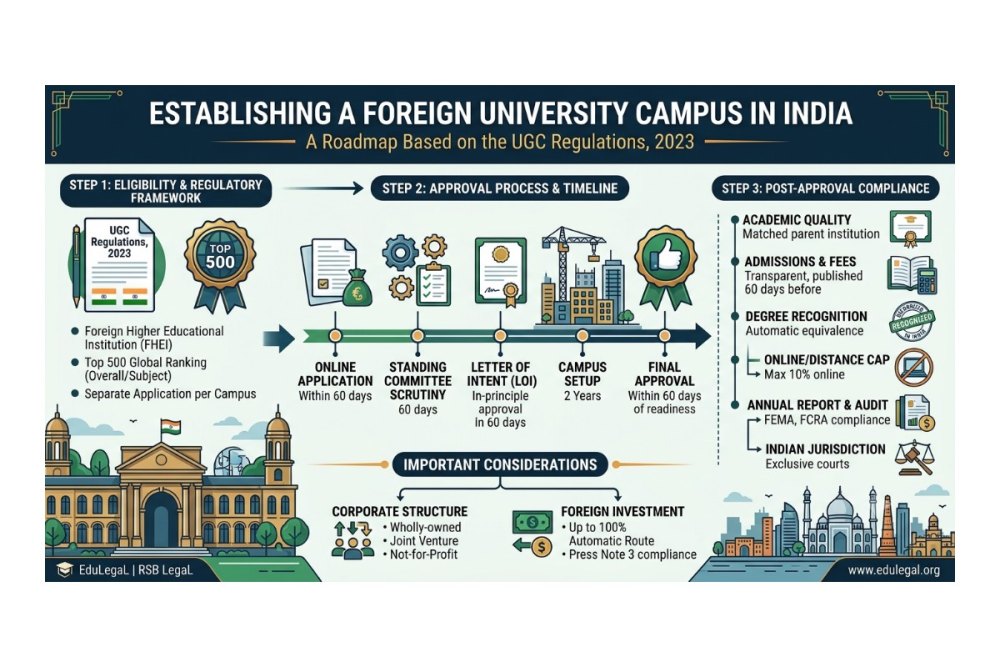
India now allows a foreign university to set up its own campus under the UGC Regulations, 2023. The route needs a top 500 ranking or outstanding expertise, a Letter of Intent, and final approval within 2 years of set up. This article explains who is eligible, how the approval works and what must be complied with after it.
India permits a foreign university to open its own campus under the University Grants Commission (Setting up and Operation of Campuses of Foreign Higher Educational Institutions in India) Regulations, 2023.
Eligibility
Clause 3 allows a foreign institution to apply if it ranks among the top 500 in a reputed global ranking, either overall or in a subject, or if it is an institution of outstanding expertise in a particular field. In the event that more than one foreign institution collaborates, each of them must meet the same test. The Regulations also allow a joint venture with an Indian institution or company, and the Indian campus must have its own independent infrastructure. The application must be made separately for each campus.
The approval process
The process in clause 4 runs in stages, and each stage carries its own time limit.
- The applicant files the application online with the non-refundable fee, along with the documents prescribed by the UGC.
- A Standing Committee of the UGC examines the proposal and gives its recommendation within 60 days of receiving the application, complete in all respects.
- On that recommendation, the UGC grants in principle approval and issues a Letter of Intent, again within 60 days.
- The Letter of Intent does not permit teaching. The institution must set up the campus within 2 years from the date of approval, and the UGC may extend the time on a case by case basis. The text does not say which approval starts the period, so the institution should treat the date of the Letter of Intent as the safe date.
- On completion, the institution gives notice of readiness. After verification, the UGC grants final approval within 60 days, with or without conditions.
Compliance after approval
The Regulations place continuing obligations on the campus. Under clause 11, the UGC may cancel, suspend or withdraw the approval for a breach, after recording reasons, and may take such other action as it considers fit.
· The campus may evolve its own admission process and criteria. The fee structure must be transparent and reasonable, and the prospectus must be published at least 60 days before admissions open.
· The programmes and the quality of teaching must match those of the parent institution. A new programme needs the prior approval of the UGC.
· Fully online and distance programmes are not permitted, and online lectures are capped at 10 percent.
· Degrees are awarded in the name and seal of the parent institution. They are equivalent to the corresponding Indian degrees, and no further equivalence needs to be sought from any authority.
· The campus must comply with FEMA and FCRA. An annual report and an annual audit report certifying the same must be filed with the UGC.
· The UGC may inspect the campus. The campus may not close without the approval of the UGC, and the students must be given alternatives and a grievance mechanism.
· Under clause 12, the Indian courts have exclusive jurisdiction in disputes.
Structure and foreign investment
The Regulations are silent on the legal form of the campus. The usual choices are a wholly owned Indian company, a joint venture with an Indian partner, or a not for profit entity such as a Section 8 company, trust or society. Foreign direct investment in education is permitted up to 100 percent under the automatic route, subject to the applicable laws and sectoral conditions. A not for profit entity generally cannot take foreign investment and will be governed by the foreign contribution law. Under Press Note 3 of 2020, investment where the beneficial owner is situated in, or is a citizen of, a country that shares a land border with India needs prior Government approval. The choice should be made with advice before the application is filed, and it must be consistent with what the application states.
Other routes
A foreign university may also enter through the International Financial Services Centres Authority framework at GIFT City, Gujarat, or collaborate with an Indian institution under the UGC twinning, joint and dual degree regulations of 2022. These routes carry different conditions and are not a campus under the 2023 Regulations.
Examples
· The University of Southampton received its Letter of Intent on 29.08.2024 and began operations at Gurugram in the 2025 to 2026 session.
· Deakin University, the University of Wollongong and Queen's University Belfast have begun operations at GIFT City under the IFSCA route.
· On 09.06.2026, the Ministry of Education handed over Letters of Approval to the University of Bristol and the University of York for campuses in Mumbai, and to the University of New South Wales for a campus in Bengaluru.
The number of approvals changes often and differs between reports. The current list should be taken from the UGC website.
Practical advice
Foreign universities should initiate entity incorporation, FEMA/FCRA structuring, tax planning, land acquisition, campus fit-out, and cross-border remittance planning in parallel with and preferably before filing the UGC application.
The two-year establishment window begins upon in-principle approval/issuance of the LoI. Because infrastructure development, regulatory approvals, staffing, and fund remittances can require substantial lead time, early structuring is essential.
Ravi Bhardwaj, Education Law Practioner.
This article is for general information and is not legal advice.
Need advice on this?
EduLegaL, A Division of RSB LegaL. Write to us at mail@edulegal.in or use the contact page.
This page gives general information only and is not legal advice. Please read the original text before acting.